Meet The Commentator: Why Your Child's Inner Critic Isn't the Enemy
C. Woodward
Author
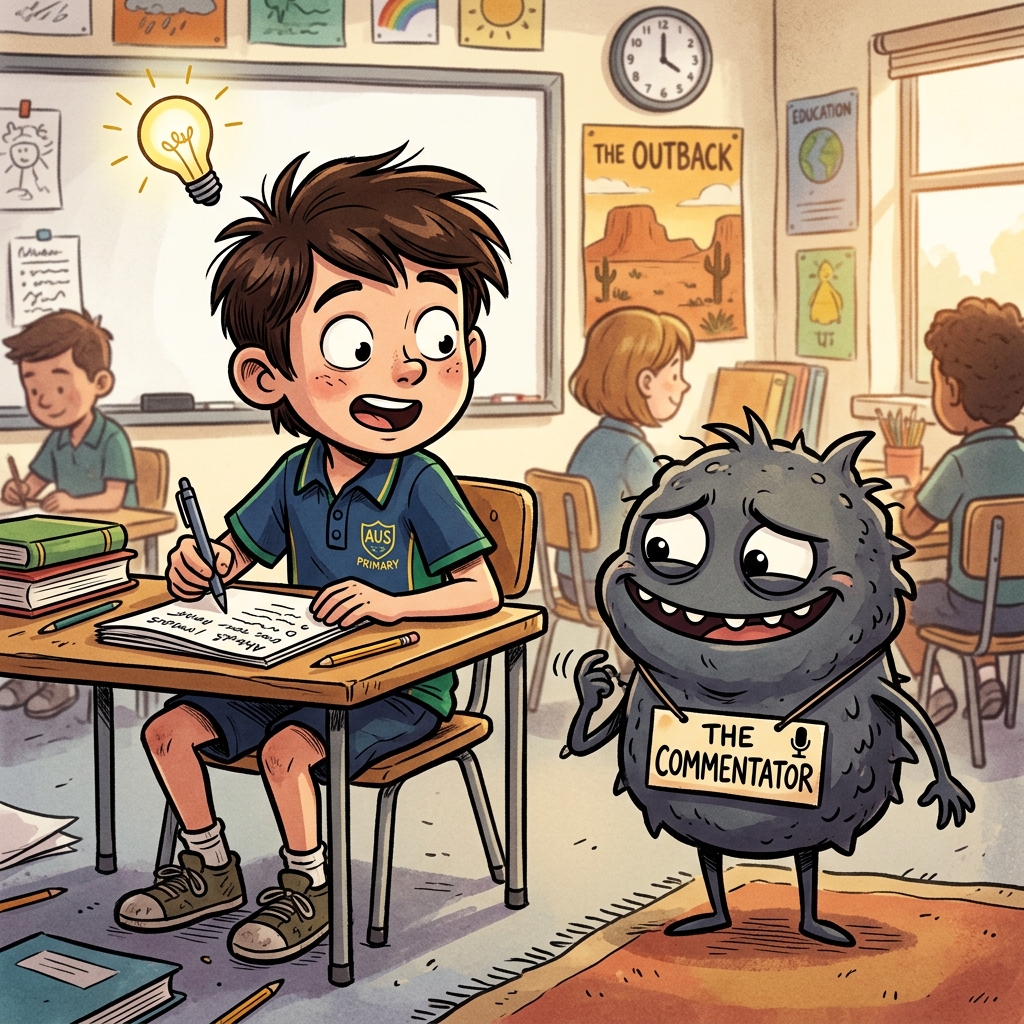
If you ask a classroom of 10-year-olds if they ever hear a voice in their head telling them they can't do something, almost every hand will go up. It's a universal human experience, yet we rarely teach kids how to handle it.
In The Voice in Charlie's Head, this inner critic is personified as a character called The Commentator. But there is a very specific reason why The Commentator isn't portrayed as a monster or a villain.
The Commentator is Just Trying to Help (Badly)
From a psychological standpoint, our inner critic often develops as a misguided defense mechanism. It highlights our flaws and predicts failure in an attempt to protect us from disappointment, social rejection, or physical harm. It's like an overactive smoke alarm that goes off when you're just making toast.
When kids understand that their Commentator isn't evil—it's just scared and untrained—it completely changes their relationship with their own anxiety.
How to Introduce The Commentator in the Classroom
Teachers can use this concept to create a shared, non-judgmental language in the classroom. Here are a few ways to bring it to life:
- Externalize the voice: Have students draw what they think their Commentator looks like. Is it small and grumpy? Is it a fuzzy creature hiding under a desk? Drawing it puts the voice outside of themselves.
- Normalize the experience: Share a mild, age-appropriate example of your own Commentator. "My Commentator told me I was going to mess up this lesson today! I had to tell it to take a break."
- Teach the "Catch It" step: When a student makes a harsh self-statement ("I'm so stupid"), gently pause them. "Hold on, is that you talking, or is that The Commentator?"
By making the inner critic a character, we remove the shame. We teach kids that having negative thoughts doesn't mean there is something wrong with them—it just means they have a Commentator who needs a little coaching.